News
Latest news
23 February
Frameless Premieres The Whale
A bold new experimental theatre experience by Expand-funded Bristol-based writer and UWE Bristol lecturer Sharon Clark, and artist and creative director Jack Hardiker-Bresson, introduces a new form of creative captioning to make storytelling more accessible and dynamic than ever before.
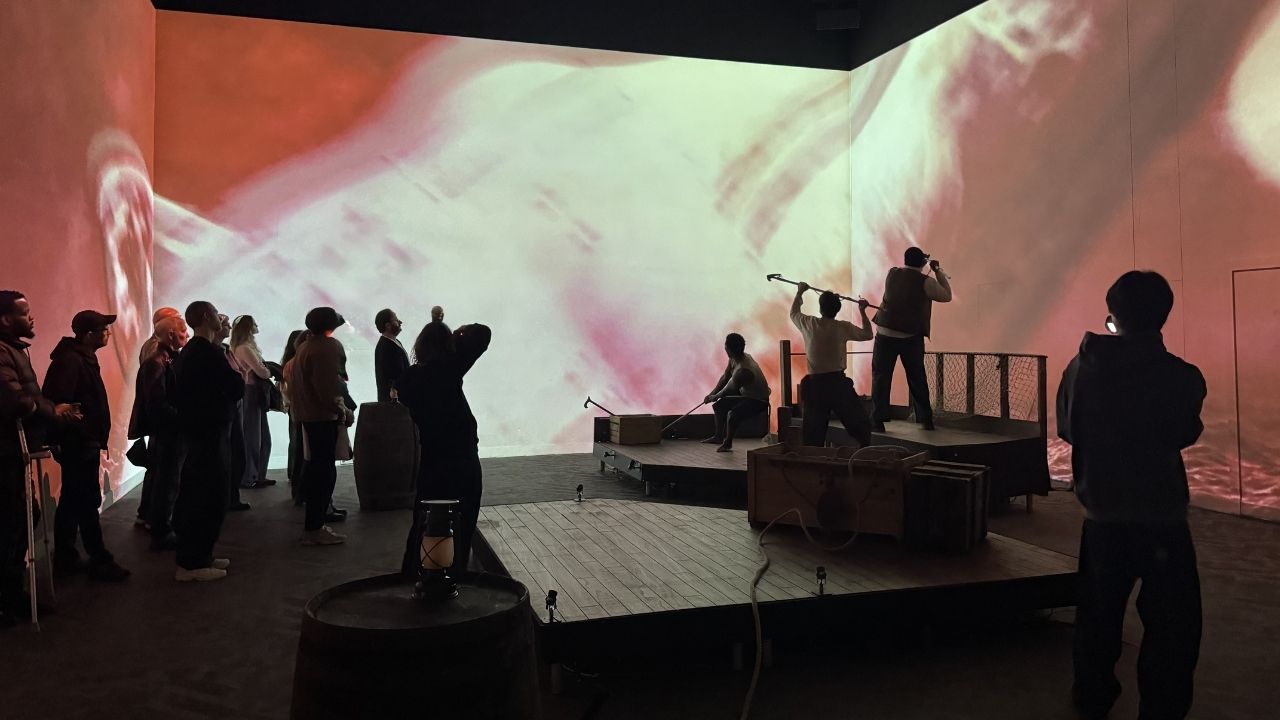
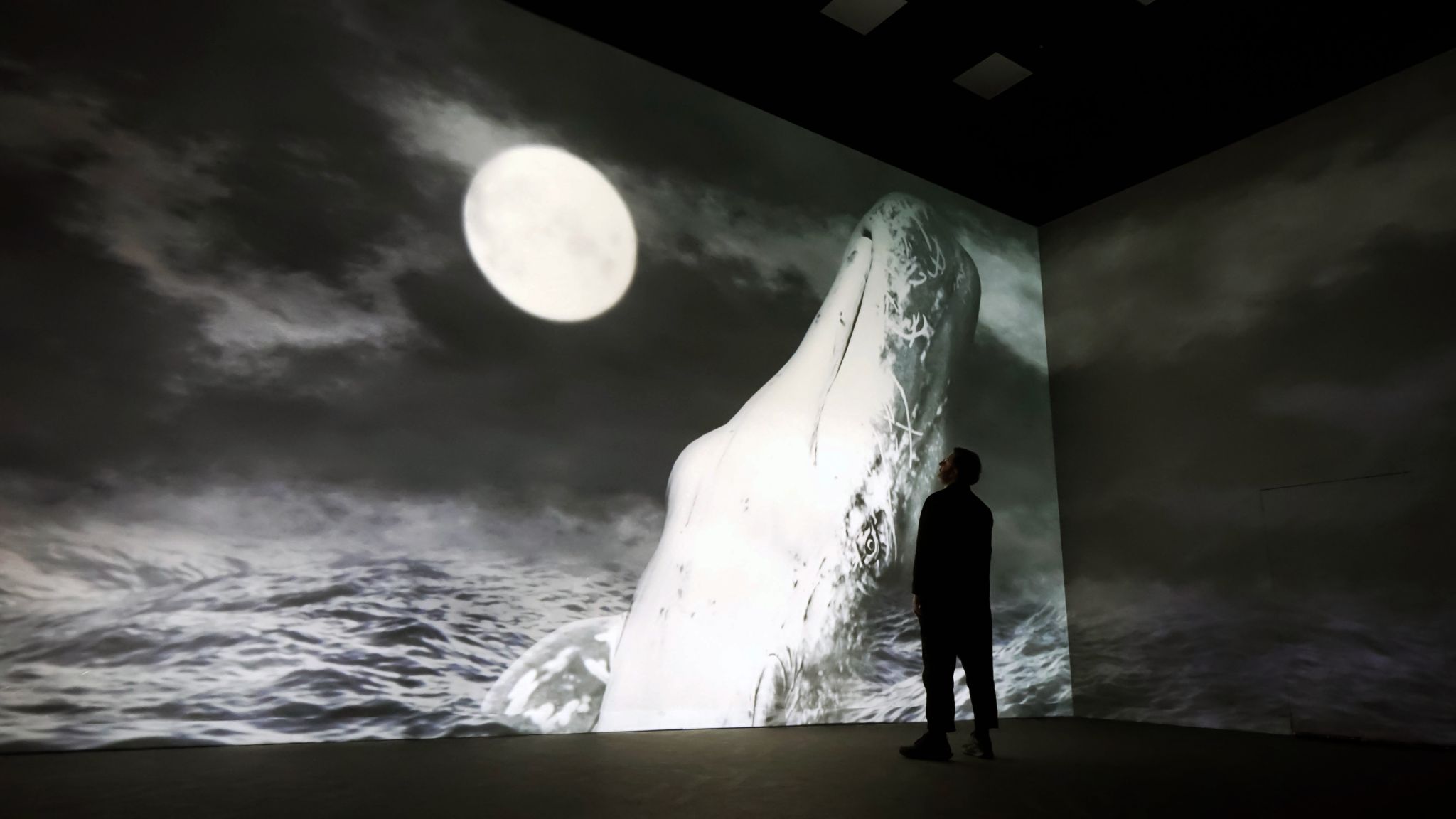
Premiering at FRAMELESS in London, The Whale reimagines the literary classic Moby Dick, blending live performance with technology, art, music and audience exploration to push beyond the boundaries of traditional theatre.
The project was one of nine to receive £50,000 through the Expand strand in the first round of Immersive Arts funding.
Designed for audiences aged 12+, the 20-minute experience is a showcase event, pioneering a new hybrid form of theatre combining large-scale 180° projections, live performance, a physical set, spatial sound and an original score.
A specially developed system of spatial creative captioning weaves text directly into the environment. Developed with Deaf, deafened and hard of hearing communities, it responds to a growing demand for captioned experiences.
Sharon, senior lecturer in professional and creative writing and creative director of Raucous at Pervasive Media Studios in Bristol, and Jack Hardiker-Bresson, creative director of Office of Everyone and tutor (research) on the Digital Direction MA at the Royal College of Art (RCA), co-led a team of theatre and XR professionals, including Deaf video designer and creative captioner Ben Glover.
Sharon said:
“As a theatre maker and writer, I’m genuinely excited about ‘The Whale’ – it’s become a piece that has kept on surprising the creative team as we design and create it,” said Sharon. “There’s something about live performance being sited in large scale projection that delivers an immersive story world that is vital and vibrant, and I can’t wait for audiences to make that discovery.”
Jack said:
“In our work, immersive technology is less about spectacle, and more about deepening the connection between audience and story. The first time I stepped into an immersive projection gallery, I was struck by the potential of bringing the fragility and immediacy of live performance together with technology at this scale. With the support of our partners, we’ve been able to test ideas that genuinely feel very new, building on processes that have been around for hundreds of years. Projection has been part of theatre since the magic lantern in the 1600s, but enveloping both performers and audiences inside 180° projected worlds creates new connections between performance and audience, and between the digital and physical.”
In The Whale, captioning – which is often treated as an afterthought or add-on in traditional performance – is a core creative element, integrated into the storytelling. Every aspect of the production has been designed with the audience’s experience of viewing them in mind, from character movement to audience positioning. They are creative and expressive, using visual effects to reflect tone and emotion, like an animated picture book.
Jack continues:
“A real artistic turning point came during early R&D at the RCA when we first layered Ben Glover’s creative captions into the spatial animation. Seeing the text sit inside the visual world felt like stepping into a living, breathing picture book. That was when the possibilities really opened up, and accessibility became a vital creative force in the work. I’m excited to see how audiences respond and what new possibilities it opens up for ‘The Whale’ and across inclusive live performance.”
Learnings from this experimental run with a live audience will inform and drive the creation of a full-length production at a later date.
Research and development for The Whale’ has taken place in, and been supported by, the RCA’s Snap Visualisation Lab and staff. The team also worked with UWE Bristol drama students at the university’s new Bridge Studios – an interactive space used during the project’s development.
Sharon added:
“Having the support of Immersive Arts has given us the freedom to be truly ambitious with this piece. The funding allowed us to explore the scale, projection work and imagining that ‘The Whale’ really needed to achieve what we had hoped it could. It’s meant we can follow the vision wherever it has led and held space for us to take creative risks we might not otherwise have been able to explore.”
The Whale premieres at FRAMELESS immersive art experience over the weekend of Friday 6 – Sunday 8 March with a number of performances open to the public. More information is available on the FRAMELESS website.
Funding for the Immersive Arts programme is provided through a collaboration between the UKRI Arts and Humanities Research Council (AHRC), Arts Council England (ACE), the Arts Council of Wales (ACW), Creative Scotland and the Arts Council of Northern Ireland (ACNI). Funding from Creative Scotland, ACW and ACNI is provided by The National Lottery.
For further information, images or interviews, please contact the UWE Bristol Press Office on 0117 3282208 or pressoffice@uwe.ac.uk.